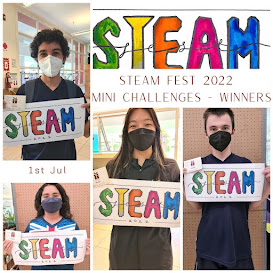
Prior to the Christmas Holidays, we launched our Mini Maker STEAM Fest Challenges. This activity marks the first step on the path to STEAM Fest 2022, which will take place later in the school year.
In the end, several students submitted their work for this activity. We received quite a variety of projects, many of which were developed based on ideas taken from the Science Buddies website, while others were innovations the students designed and developed. themselves.
At the ABC we very much value student choice, agency and endeavour so it was fitting that we recognise and highlight the work of the students who not only engaged in various challenges over the past 2 months but also shared their final projects with us.
On February 11th, each of these students were asked to visit the LRC, where they received a special, quite unexpected prize and a thank you from the organisers for taking part and for sharing their work. They can now choose whether to use their prizes to explore their favourite books or invest in further STEAM challenges at the Libreria Internacional.
Our 6th-grade students are currently working on an MYP (Middle Years Programme)unit that focuses on three ATLs (Approaches to Learning), one of which is Practicing Collaboration Skills: Practice Empathy.
The unit sets out to teach this ATL across a wide variety of experiences, one of which was a practical activity done these past two weeks.
The Statement of Inquiry for the unit is The creative development of innovative products designed to function for an individual's needs, can help lessen inequalities. Through the inquiry process students will be researching designing, developing and testing their 3D solutions for mobility challenges. It can be difficult for students to understand these challenges if they have never experienced them so we set out to give them a few mobility challenges of their own.
This is what two students had to say about that experience.
"This activity made us see how people with disabilities struggle to do things that for us are not complicated but for them are very challenging. It also made us feel disappointed because sometimes we make jokes about those topics when it is a very serious issue. What we did see was how disabled people lived their normal lives. We did this through some “games” which helped us understand what people felt.
We felt very stressed and frustrated because we couldn't do simple things like write our name or even get a cup. We think that we did this activity because it was going to be fun and to reflect on how people with disabilities live their normal lives. This made us feel guilty because we sometimes complain about little things when people with disabilities wish to have legs, arms or other parts of the human body. We hope you reflect on these issues and think about how people live their lives missing a part of their bodies that make their life complicated.
The question we have to ask you is what would you do if you were them? "
Creative learning at the LRC is alive and well. This week students had the opportunity to construct light-up Christmas cards by building paper circuits, which use paper, copper tape, battery packs and LED lights.
This is one of several Christmas-themed activities brought to our students by way of the LRC Makerspace.
A big thanks to our team of librarians for all of the exciting projects they have run for our students.
Today we were honoured with a special visit by the sub-director and librarian of Maquilishuat School here in El Salvador. During the visit, we were able to show our visitors around the physical and digital LRC as well as share good practices in the running and development of school libraries as resources centres for learning. Our primary focus was on educational provisions for the school community, collection access, and development, community service projects, and digital equipment and resources.
The visit would not have been complete without an opportunity to explore experiential learning ideas featuring some of our favourite digital learning tools including Ozobot, Sphero Mini and Bolt, and Lego Robots, our beloved 3D printers and pens. We also had an opportunity to share our current VR and AR provisions including Oculus Quest, Google Cardboard, and Merge Cubes. These technologies while used by students from 6th-12th grade in certain subjects will soon form the backbone of our proposed LRC Mixed Reality Lab or MR Lab for short.
The MR Lab is an internal project which the LRC Team has begun to develop in conjunction with the ICT department. Through this project, we endeavor to insert AR and VR experiences more predominantly into student learning across disciplines both within and outside of lessons, in a safe, dedicated space, within the LRC. It will provide opportunities to explore both virtual and augmented reality through preexisting experiences across platforms, as well as provide the resources for students to view and interact with their own design projects in 3D and 360-degree formats. We will share more on this in future blog posts, as the project develops further.
As educators, we believe it is vital for schools to work together as part of the larger educational community. This is a vision we share with many of the educational organisations in the country including La Escuela Maquilishuat. Communication, shared initiatives, and support between centres of learning and their libraries are fundamental to meeting the current and projected needs of our school communities and it is important that we explore ways in which to address the challenges facing institutions, together. Our meeting, therefore, would not have been complete without a discussion of the concerns facing libraries today and strategies for further improvement and outreach within our educational communities. As a result, we have also identified further opportunities through which to further extend the relationships that currently exist between our two schools and have planned to meet up again in the new year to discuss additional collaborative initiatives and events between the two schools.
One such opportunity was that of the Sleeping Mat Club in which students work together outside of normal lessons to create sleeping mats out of plastic bags for those less fortunate than themselves.
Here is the link to our Flickr Album of photos of the visit.
Today the LRC Team had a visit from a group of Library Sciences students from the University of El Salvador. This was a follow-up session from a virtual meeting a week ago in which the students interviews the librarians about the LRC and its workings.
We were asked for a tour but prepared an experience for them that we hope not only illustrated many of the functions and purposes of the LRC in an engaging way but also, highlight ways in which they as future librarians can engage members of their communities through experiences which can be adapted across subjects and grades, at a low cost or no cost.
This was an enjoyable experience for all and many important connections were made.
We have encouraged the students to keep in touch and keep us abreast of their professional endeavors. We do hope that the students will take us up on our offer to support them as they move from university to their first library postings.
It is a wonderful thing to hear that we are considered by many, including university professors to be the best school library in the country. The LRC has come a very long way since 2008 and we endeavor to ensure that the innovative learning, resource collections, community engagement, and support continue to develop and improve, in the benefit of our ABC and local communities.
The long-awaited online Exhibition launched on Wednesday of this week.
Projects for this modified version of our annual STEAM Fest extravaganza were drawn from the work of students across the secondary school, the majority of which were developed in their ICT lessons, but some of which were developed by the students outside of lessons as well.
We invite you to view the site and the projects on our STEAM Fest website. Do be aware that much of the content is set at private, viewable by the ABC community, in order to protect the privacy of our students. If you cannot view it, do ask your son or daughter, brother or sister to log in with their ABC credentials so you can view it together.
This year we participated once again in the Salvadoran Library Association's Cultural Week. This year was the 32nd and was declared the Ibero-American Year of Libraries- Libraries Building the Future.
During the sessions, we shared our experiences with the challenges brought on by a change from interactive physical spaces to interactive virtual spaces, as well as the tools that allowed us to facilitate these changes.
We also discussed the challenges of online education, in particular the lack of access to our physical teaching resources (computers, book collections, 3D design printing equipment, electronics, and robotics sets, the kitchen, and more) and how we managed to facilitate electronic access to learning in these areas, albeit in a different manner.
One of the main challenges we focused on was the need to modify our approaches as we went from having personal contact with students and sharing learning experiences, in an environment rich in educational resources available to students, to a more restricted environment via online access and communications.
In doing so we were able to share how this experience not only allowed us to operate fully with modifications during the closure of spaces brought on by the pandemic but also impacted the manner in which we will operate post-pandemic. The result was a series of short workshops in which we taught our colleagues some basic practices for services that can be delivered electronically and with it provided a list of useful, free, resources that can be shared with the rest of the community.
We focused on the ease of use and the potential impact the following tools can bring to any library setting:
-Create interactive spaces with slides and Bitmoji
- Basic photo editing
- Google devices
- Websites
- Canva
It was a pleasure to always share with our fellow librarians and teachers, to create important links here at home and abroad, and continue to learn together as a community.
Taller: Superar los desafíos del encierro. El caso del Centro de Recursos de Aprendizaje de la Academia Britanica Cuscatleca (LRC).
Spanish Version
Este año participamos una vez más en la Semana Cultural de la Asociación de Bibliotecarios Salvadoreños. Este año fue el número 32 y fue declarado Año Iberoamericano de las Bibliotecas - Bibliotecas Construyendo el Futuro.
En el contexto de la pandemia, compartimos con la comunidad más amplia de bibliotecarios nuestras experiencias con los desafíos provocados por el cambio de espacios físicos interactivos a espacios virtuales interactivos, así como las herramientas que nos permitieron facilitar estos cambios.
Al hacerlo, reflexionamos sobre los desafíos de la educación en línea, en particular la falta de acceso a nuestros recursos físicos de enseñanza (computadoras, colecciones de libros, equipos de impresión de diseño 3D, conjuntos de electrónica y robótica, la cocina y más) y cómo logramos facilitar acceso electrónico al aprendizaje en estas áreas, aunque de manera diferente.
El principal desafío fue, sin duda, nuestra mentalidad al pasar de tener contacto personal con los estudiantes y compartir experiencias de aprendizaje, en un entorno rico en recursos educativos disponibles para los estudiantes, a un entorno más restringido a través del acceso y las comunicaciones en línea. Al hacerlo, pudimos compartir cómo esta experiencia no solo nos permitió operar completamente con modificaciones durante el cierre de espacios provocado por la pandemia, sino que también impactó la forma en que operaremos después de la pandemia. El resultado fue una serie de talleres cortos en los que les enseñamos a nuestros colegas algunos conceptos básicos para los servicios que se pueden entregar electrónicamente y con ello proporcionamos una lista de recursos útiles y gratuitos que se pueden compartir con el resto de la comunidad.
Al hacerlo, nos centramos en la facilidad de uso y el impacto potencial que las siguientes herramientas pueden aportar a cualquier entorno de biblioteca:
-Crear espacios interactivos con diapositivas y Bitmoji
- Edición de fotos básica
- Dispositivos de Google
- Sitios web
- Canva
Fue un placer compartir siempre con nuestros compañeros bibliotecarios y profesores, para crear vínculos importantes aquí en casa y en el extranjero y seguir aprendiendo juntos como comunidad.